
What Screenwriting Teaches You About College Essays
By Ryan Jaffe ·
College essays fail for the same reasons scripts fail: nothing happens early enough, the details could belong to anyone, the writer explains what the reader should be discovering, and a theme gets attached at the end like a tag on a suitcase. Screenwriting has spent a century developing exact language for those problems, and every one of those tools transfers to a 650-word personal statement. This page lays out the whole method in order, and points you to the piece that goes deep on each part.
I have spent twenty years writing and directing films and television, which mostly means twenty years of having work rejected in specific, useful ways. Those rejections come down to a small number of recurring notes, and students get versions of the same notes, usually without anyone naming the underlying problem. Naming it is most of the fix. What follows is seven principles, in the order I use them when I read a draft.
1. The inciting incident has to arrive early
In screenwriting, the inciting incident is the event that disturbs the balance of a character's life and forces a response. Before it, there is routine. After it, there is a problem. The single most common note a screenwriter hears is that the inciting incident is too late.
Open a stack of first-draft personal statements and the same thing is happening. The first paragraph is atmosphere. The second is context. The third explains the student's background. Somewhere on page two, something finally occurs. In 650 words there is no page two. Whatever disturbs the balance needs to be inside the first three or four sentences, and the reader needs to be able to feel that a decision is coming.
The practical version of the note is brutal and it works: find the first moment in your draft where something changes, delete everything above it, and see what you lost. Usually nothing. The material above that line was you clearing your throat — normal in a first draft, fatal in a final one.
That's the structural half. The sentence-level half, including why "orientation" openings and famous quotations both fail, is worked through in the post on what the first sentence is actually for, which makes the case that an opening's only job is to make the second sentence necessary.
2. Someone has to want something
This is the principle with no post of its own, and it is the one I'd keep if I could only keep one.
Every story is a person wanting something and having trouble getting it. That is not a rule about genre; it is the definition of a story. Remove the want and you have a description. Remove the trouble and you have a report. Both of those are things a reader can put down without feeling they missed anything, which is exactly what you cannot afford.
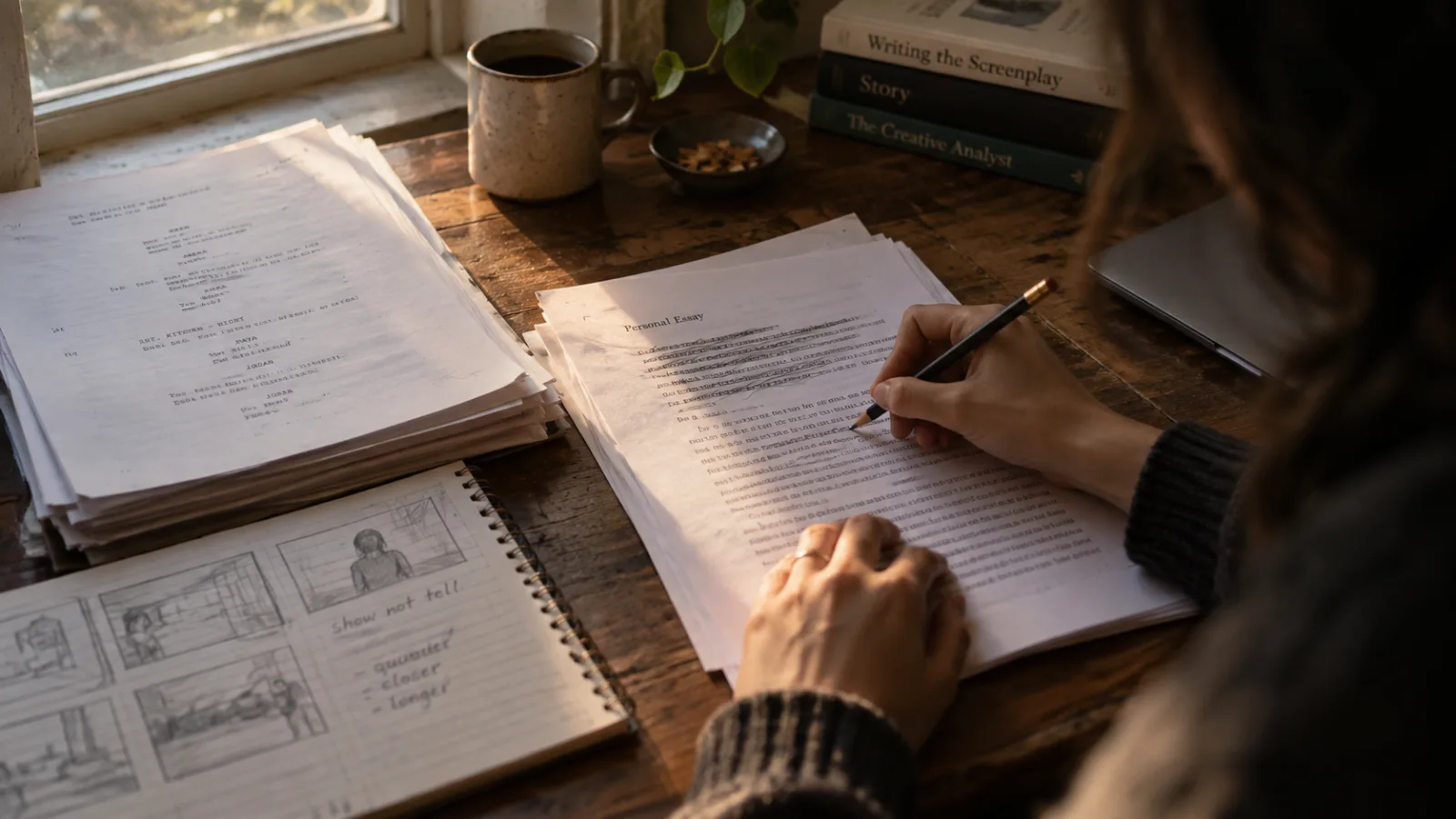
Student drafts fail this test constantly, and the failure is invisible because the draft is otherwise competent. A student describes two years of volunteering at a food bank: what they did, who they met, what they observed. Every sentence is true. Nothing in it is wanted. There's no moment where the writer needed something and had to do something uncomfortable to get it, so there's no reason for the paragraphs to be in that order.
The want doesn't have to be large or noble. In a script it's frequently small and slightly embarrassing: to not be humiliated at the meeting, to get one person to take you seriously, to finish the thing before anyone notices you started. Small wants beat grand ones because they're specific and because they produce behavior. "I wanted to understand my heritage" produces nothing. "I wanted my grandmother to let me cook the dish without standing behind me" produces an entire essay, because now there's a person on the other side of it and something has to give.
So before you fix any sentence, answer two questions in plain language. What does the person in this essay want? What is in the way? If you can't answer both in a short sentence each, no amount of line editing will make the essay move, because the problem is that nothing is moving. Find the want and the structure usually assembles itself around it.
3. Specificity is evidence, not decoration
Screenwriters talk about generals and specifics. A general is "a nice house." A specific is "a house where the hallway is lined with framed photos of the same three cousins at different ages."
Specifics do two jobs at once. They create an image, and — this is the part students miss — they characterize the person who noticed them. Every detail is evidence about the narrator, because the narrator selected it. A student who describes a kitchen in terms of sound is telling you something different about themselves than one who describes it in terms of order. You're being read the whole time you think you're describing something else.
The working rule on my own pages: every scene needs at least one detail that couldn't have been guessed. Describing a hospital waiting room, skip the fluorescent lights and the antiseptic smell, because the reader supplied those already. Give them the thing only you would have noticed. This kills cliché automatically, since a cliché is just a detail that arrived without being noticed.
Two posts run at this from different sides. The one I'd send a stuck student to first argues that essays get their power from the quality of the noticing rather than the size of the event — it is the answer to "nothing has happened to me," and it is where most topic panic actually gets resolved. The other applies the same standard to supplements, showing that the "why this school" answer is the one place a college can tell whether you know anything real about it, and that generic praise there is more damaging than students assume.
4. Scenes, not synopsis
A script is scenes. A synopsis is a summary of scenes. They contain the same information and they do completely different things to a reader, which is why nobody gets financing off a synopsis.
A personal statement written as synopsis reads like this: over the course of my junior year I gradually came to understand that leadership requires listening. That's a season compressed into a claim. The same material written as scene is a Tuesday, a room, two people disagreeing, and a decision. One of those the reader watches. The other the reader is told about, and being told is forgettable.
This is also the honest answer to the word count complaint. A student who "needs more space" almost always needs a smaller subject, because a single afternoon rendered closely fits in 650 words while a whole year never will. The case that 650 words is plenty and that the problem is wanting too much from the essay has the best diagnostic I know: if cutting a third feels impossible, you're covering a season instead of a scene. And the argument that the essay's real job is the one thing the rest of the application cannot do is worth reading before you pick a topic at all.
5. Theme is dramatized in behavior, or it isn't there
In a script, theme is what the story is about underneath the plot. Every working screenwriter knows the same unglamorous fact about it: theme cannot be added later.
If a film is genuinely about the cost of ambition, that idea lives in which scenes exist, in what the character wants, in what they are willing to give up to get it. It is structural. If it isn't structural, you cannot repair it by having someone announce it in the third act. Audiences feel the seam. Admissions readers have precisely the same instinct, developed over a much larger sample size.
The stapled-on theme is easy to spot. There's a decent story about a summer job, then a final paragraph asserting that the experience revealed a commitment to public service. The story doesn't contain that idea. The claim arrived from outside, usually because a well-meaning adult said the essay needed a bigger takeaway. The fix is never a better final paragraph. It's putting the meaning into the material: if the essay is really about what you owe people you aren't related to, then the details you select, the moments you slow down on, and the thing you decide at the end all have to be in that key. Then you don't need a concluding thesis, because the reader already has one and trusts it more for having built it.
Screenwriting calls the dialogue version of this "on the nose" — characters saying exactly what they mean and feel. It reads false because people almost never do that. Two posts cover the admissions version. One argues that nobody believes a claim about character and you should stop arguing for yourself, the cleanest statement of the principle on the site. The other handles the hardest case, writing about something painful without converting it into a redemption pitch — the same error at higher stakes, because a reader feels it when suffering is being cashed in.
For what it's worth, this is not theory I picked up from books. I wrote the Osbourne biopic Sharon, about Ozzy and Sharon Osbourne, which was named to the 2018 Black List — the annual industry survey of the most-liked unproduced screenplays. The entire problem of that script was the one students face: a real person's actual, unshaped life, and the job of finding which moments carry the meaning without anyone on screen ever stopping to state it. You solve it by choosing scenes, not by adding summary.
6. Voice is selection, not style
This is the other principle with no post of its own, and it's where most drafts either become someone or stay anonymous.
Students hear "voice" and think flourish: unusual words, a striking metaphor, a distinctive turn of phrase. That's style, and style is the smaller thing. Voice is the consistent set of things a particular person notices, cares about, finds funny, and refuses to say. You can identify a writer's voice from a paragraph containing no adjectives at all, because voice lives in selection and rhythm. What you leave out is voice. What you find worth mentioning is voice. Where you stop a sentence is voice.
The most common voice problem in student essays is not an absence of style. It's borrowed register — the student writing in a formal, faintly institutional English they have never used in life, because they believe that is what an essay sounds like. "I was afforded the opportunity to participate in" is not a voice. It's a costume, and it fits nobody.
The fix is mechanical and it's the highest-yield thing in this entire piece: read the essay out loud, start to finish, and rewrite any sentence you wouldn't actually say to a person standing in front of you. You'll find the costume sentences instantly, because your mouth resists them. You'll also catch rhythm problems no silent read will surface: four sentences in a row of identical length, the paragraph with no place to breathe, the clause that made sense on the page and collapses in the air. Do this twice, on separate days.
The one place voice gets actively dangerous is comedy, which is why it has a post of its own: the argument that humor has to come out of the material rather than be applied to it is worth reading before you attempt a joke, because a joke that misses costs you the reader in a way an earnest sentence never does.
7. Cut structurally, and know who's reading
Screenwriters overwrite on purpose, because you cannot tell what a story is until you've written past it. Then they cut whole scenes rather than trimming adjectives. Write 1,000 words for a 650-word essay and cut sections, not words. Film editors have a companion rule worth stealing: enter the scene as late as possible, leave as early as possible. Most paragraphs in a student draft can lose their first and last sentence without losing anything at all.
All of this only matters because of who's on the other end, and the single most clarifying thing you can read before revising is the account of what an admissions reader actually does with your essay in the few minutes it gets, which explains why pacing is not a stylistic preference but an arithmetic constraint.
Three more pieces cover the practical frame. On timing, the post on when to start argues that earlier means calmer rather than better, and that the real risk for a late starter isn't the calendar but writing without a reader. On authorship, why I don't use AI on a student essay is a practical objection, not a moral one: the output is competent and average, and average is the one thing an essay can't be. And for the parent reading this instead of the student, the guide to helping without taking it over draws the line where I draw it — supply the memories your kid has forgotten, not the sentences.
FAQ
Does a college essay really need story structure? It needs movement and a reason to keep reading, which is what structure provides. It does not need three acts. It needs something off balance early, someone wanting something, and something different by the end.
What is an inciting incident in a college essay? The moment something changes and a response is required. In 650 words it should appear within the first three or four sentences, not on a second page that doesn't exist.
How do I find my voice in a college essay? Read every sentence out loud and rewrite anything you would not say to a person standing in front of you. Voice is mostly a matter of removing the formal register students think essays require, and it lives in what you select, not in how you decorate.
Why do admissions readers dislike a big lesson at the end? Because meaning announced in the last paragraph but absent from the story reads as added on. If the material doesn't contain the idea, stating it only makes the seam visible.
Where should I start if my draft is a mess? Answer two questions in one sentence each: what does the person in this essay want, and what is in the way. If you can't, that's the problem, and no line editing will touch it.
Book a free 20-minute intro call: https://calendly.com/ownyouressay/intro